
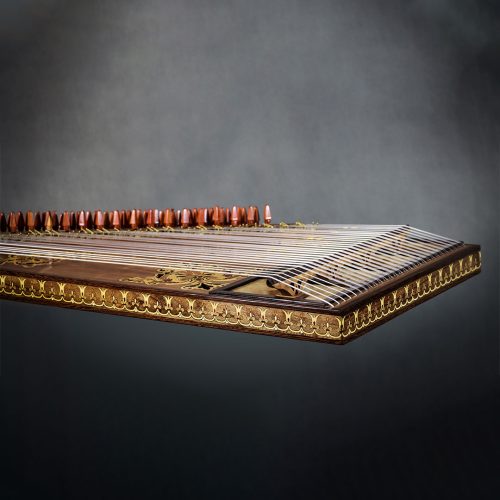

History of the Qanun Instrument
The Qanun is one of the oldest Iranian musical instruments, fully capable of expressing the gushehs (melodic modes) of Iranian music. Unfortunately, it has remained largely unknown in its homeland for a long time, while in neighboring countries it has been widely used for centuries. From about half a century ago, Iranian musicians began to perform on this instrument again. However, although their musical foundation was rooted in Iranian music, unconscious imitation of Arabic performance methods and styles led to the false assumption that the qanun is an Arabic instrument and should be played in the Arabic style.
This misconception has distanced many Iranian music enthusiasts from understanding the true principles and subtleties of the instrument, which in fact can be fully aligned with Iranian music. In recent years, some Iranian qanun players and teachers have also turned toward Turkish performance styles, often influenced by strong promotion of Turkish instruments and the advanced qanun-making industry in Turkey. As a result, the Turkish qanun has gained more attention than the Iranian qanun.
Since playing any instrument and drawing out its diverse musical possibilities depends not only on the performer’s skill but also on the capabilities and limitations inherent in the instrument’s structure, a fundamental reconsideration of the qanun is necessary. For centuries, the qanun evolved outside its homeland, Iran, mainly in Arabic-speaking regions and through Armenian intermediaries, developing an expression disconnected from Iranian music. Therefore, the qanun must be played according to Iranian musical expression, incorporating the specific capabilities, principles, and subtleties of this tradition—such as its unique system of microtonal intervals.
Our responsibility is to restore the performance practice of the qanun based on Iranian music and to ensure its correct teaching and learning. While the common methods used in neighboring countries may also be studied, the most important principle in teaching and performing the qanun is to respect its original standards, structure, and cultural origin.
There is extensive historical evidence regarding the qanun. One example is the writings of Abd al-Qadir ibn Ghaybi al-Hafiz al-Maraghi, who lived between 750 and 840 AH in Maragheh, in present-day Azerbaijan (Iran). He was a scholar, master musician, performer, composer, and author of several important books and treatises on music.
In one of his books, he describes the qanun as an instrument with a triangular soundboard and body, strung with metal or non-metal strings. One end of the strings was fixed with pegs or pins, while the other end was wound around tuning pegs and tightened. Every three strings produced a single pitch, and the tuning system arranged the notes in pleasant, successive intervals, forming eight consecutive notes with regular spacing.
Henry George Farmer (born 1882), an Irish musicologist and historian and a professor of music at Cairo University, author of A History of Scottish Music and A History of Military Music, referred to instruments known as Psalterium and Nozhah, which were identified as forms of the qanun.
The qanun is traditionally attributed to Al-Farabi, the great Iranian scholar, while the Nozhah is considered an innovation of Safi al-Din Abd al-Mu’min, a musician at the court of the last Abbasid caliph of Baghdad.
The Nozhah was made of cypress wood and sheep gut strings, with 81 strings stretched across two rows of bridges. Since every three strings produced one pitch, the instrument had a range of 27 pitches.
The Psalterium was trapezoidal in shape, or according to the book Kanz al-Tuhaf, half-rectangular, and had 64 strings. In the lower register, every three strings produced one pitch; in the middle register, every two strings produced one pitch; and in the bass register, single strings were used. Due to the trapezoidal shape of the instrument, the string lengths varied.
Farmer explains that the trapezoidal psalterium was placed parallel to the row of tuning pegs. The performer held the instrument with the left hand and plucked the strings with the right hand. In Syria, this instrument was known as the qanun, while in Egypt it was called the santir.
He also notes that some versions were made of silver or gold, although for better resonance, a wooden soundbox was preferred.
Ibn Hazm referred to the qanun as the leader of instruments.
Scholars such as Kurt Reinhard, Simon Jargy, Habib Hassan Touma, Khachatur Odishian, Omid Motlu, and Amin Shahmiri have also presented valuable research on the qanun, which is discussed in the introduction to Volume One of the Qanun Method, authored by Master Maliheh Saeedi.
In fact, based on historical documents and evidence, the qanun is considered an innovation of Abu Nasr Muhammad ibn Tarkhan ibn Uzlagh al-Farabi, the great philosopher and musician, who was born in 259 AH in the Faryab region of Khorasan, near the Seyhun (Syr Darya) River. According to historical records and geographical maps reflecting the vast cultural territory of Iran, Al-Farabi was Iranian, and the invention of the qanun is attributed to him. Consequently, the qanun is an instrument of authentic Iranian origin.
One of the most important works of this Iranian philosopher is the book “Kitab al-Musiqa al-Kabir” (The Great Book of Music).