
According to international standards, in developed countries music education for children begins at an early age and is taught compulsorily as one of the core subjects in all schools. This is because musical training—especially before the start of formal schooling—improves and strengthens coordination between the two hemispheres of the brain, which in .turn positively affects a child’s individual abilities and quality of life in multiple dimensions
Particularly in today’s world, where lack of concentration is increasingly common, music can be even more effective than yoga in enhancing children’s focus and memory. At younger ages, musical introduction takes place through rhythmic play. In some countries, music education begins with the piano (or mini piano), while in many others it starts with a method known as Orff, using the xylophone—an instrument structurally similar to the Glockenspiel(bells) but made of wooden bars and played percussively with two mallets. Later, to activate finger usage, the recorder .flute is introduced
Unfortunately, in our country, children’s music education is entirely optional and dependent on parental choice. As a result, families who decide to enroll their children in music classes usually take them to private music schools, where children’s music education typically begins with the Glockenspiel(bells) instrument. Today, due to higher IQ levels, lower patience, and fast-paced lifestyles, instruction in many cases ends at the bells stage, which became the first major reason to consider replacing this instrument in children’s music education. In the following .sections, the reasons for this replacement are explained in more detail through comparison
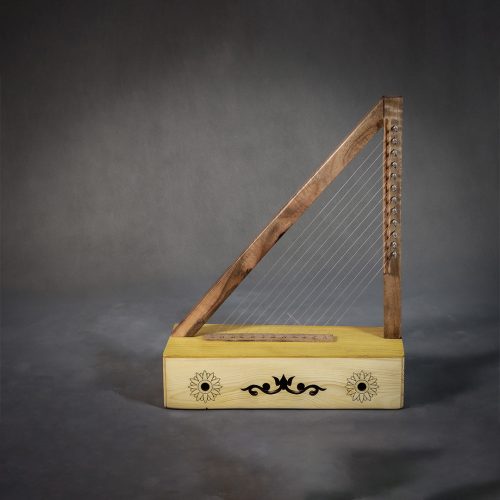
This new instrument is called the “Children’s Harp.” Its design is inspired by ancient Iranian harps, but its structure has been developed in a way that allows children to play it easily and naturally.
(Reasons for Using the Children’s Harp Instead of Glockenspiel(bells:
• The bells are played with plastic mallets, which require the child to close all five fingers around them. This prevents finger movement during performance. In contrast, playing the Children’s Harp requires all ten fingers of both hands to remain open and actively engaged. As a result, there is no longer a need for learning the recorder flute after bells (which is typically introduced solely to teach finger movement). Furthermore, as children continue their musical education and later choose a main instrument, their fingers will already be better prepared and more skillful.
• The bells are metallic and colorful, played percussively with plastic mallets. For most children, this creates the impression of a toy, which often leads to careless handling and damage. The concept of respecting and caring for the instrument is therefore not established. In contrast, the Children’s Harp is built entirely from authentic instrument materials (wood and strings) and is played with proper playing posture and technique. This encourages children to learn how to care for an instrument from an early age. In many cases, the instrument is kept as a meaningful reminder of early musical education rather than being discarded like a toy. Often, an emotional bond forms between the child and the instrument.
• The bells are a metallic instrument with 12 notes, played percussively with plastic mallets. The word bells literally refers to “chimes,” and due to their metal construction, the sound strongly resembles ringing bells. This sound can be harmful to beginners’ ears, as it unintentionally raises the child’s auditory threshold and may damage hearing. Later, when the child chooses a main instrument, this heightened auditory threshold often results in poor touch control, causing them to play too forcefully. In contrast, the soft and gentle tone of the harp preserves the child’s hearing health and later enables proper touch control when learning a specialized instrument.
• The high volume and harsh sound of the bells often cause auditory discomfort not only for children but also for their families, leading to shorter practice times at home. The gentle sound of the Children’s Harp, however, creates no such limitation and allows for longer, more comfortable practice sessions.
With the Children’s Harp, all notes, rhythmic values, and ten-finger coordination are taught comprehensively, eliminating the need for a second training phase. As a result, children are prepared to choose their main instrument in a shorter educational period. Economically speaking, although the Children’s Harp is more expensive than the bells and recorder due to the materials used, its shorter instructional period ultimately benefits families financially.