
History of the Arjan Barbat
In the autumn of 1982, during the construction of a dam on the Maroun River in the Arjan region of Behbahan (present-day Khuzestan Province), an Elamite tomb dating back approximately 3,400 years was discovered. The tomb contained a large bronze coffin shaped like a bathtub, whose lid was found placed beneath it at the time of discovery. Burial objects were found both inside and outside the coffin.
These artifacts included:
a gold ring, ninety-eight gold buttons, a dagger, a silver rod, a bronze jug, a bronze goblet, ten cylindrical vessels, and a bronze tray engraved with historical images.
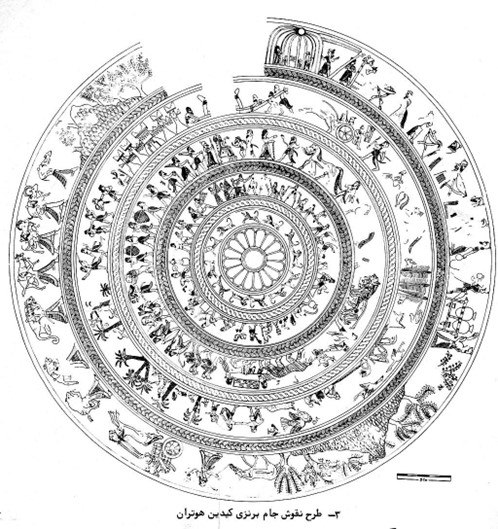
On this bronze vessel, seven engraved concentric registers can be observed. During that period—and possibly even earlier—the number seven was considered sacred and appears to have held a specific religious and spiritual significance. On this vessel, the registers are separated by braided patterns, which seem to symbolize distinct geographical or climatic regions.
Arranged by surface area:
First register: Depictions of kings, ministers, captives, hunting grounds, and animals taken as spoils for the rulers.
Second register: Representations of various social classes, including farmers, birds, and trees of that era.
Third register: The families of kings and ministers, along with their symbolic animals.
Fourth register: Various musicians playing different instruments—such as the harp, barbat (lyre), tanbira, ney, sorna, and frame drum—shown performing together as an ensemble.
Fifth register: Sacred animals with regional and ornamental significance.
Sixth register and the central seventh: A sixteen-petaled flower, a motif that existed in earlier civilizations and is considered one of the most prominent ancient symbols. This flower appears in different forms with varying numbers of petals—such as 8, 12, and 16—and is associated with solar symbolism, known by names such as chrysanthemum and lotus. Even in later periods, including the Achaemenid era, the twelve-petaled version remained a powerful symbol.
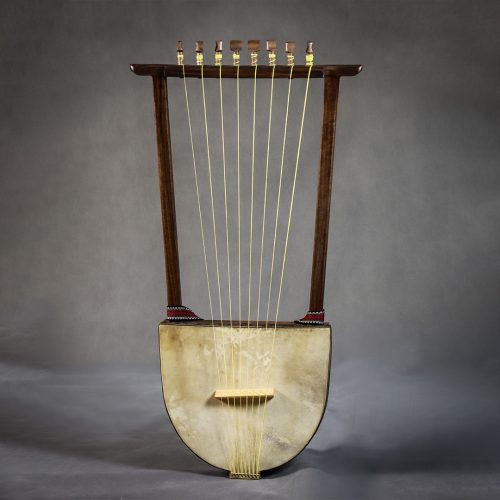
Among the engraved instruments, one is a horizontal–vertical instrument known as the barbat (or in Western terminology, a lyre). This instrument has a U-shaped frame, with a skin soundboard, and strings that pass over a bridge before being fastened to the instrument. At that time, most instruments of this family were skin-covered.
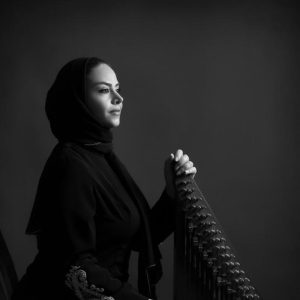
In 2011, this instrument attracted the attention of Seifollah Shokri, an instrument maker and researcher, who undertook its reconstruction and named it “Arjan”, or “Organ,” reflecting its identity in its own historical era. That same year, the instrument was played for the first time by Rabeh Zand in a reconstructed performance, and one year later it was officially performed on stage as a solo instrument.
During Nowruz 2016, the ISNA News Agency published a video interview and performance of Rabeh Zand playing the Arjan Barbat (Organ) on its platforms, which received widespread public attention. Today, this instrument is performed both as a solo instrument and within ensembles, demonstrating that the integration of ancient instruments into modern orchestras lends a profound and meaningful dimension to the world of civilization and musical orchestration.